- All
- Product Management
- News
- Introduction
- Enterprise outlets
- FAQ
- Enterprise Video
- Enterprise Atlas


Detailed description
 | Today, the world uses 3.3 high borosilicate glass to manufacture chemical anti-corrosion equipment and fittings, as well as laboratory glass instruments. 3.3 High borosilicate glass is the abbreviation for boronic acid glass with an expansion coefficient of (3.3 ± 0.1) x 10/K, commonly referred to as Pyrex glass internationally.
According to the international standard IS03587, glass pipes and fittings for chemical equipment must be made of 3.3% high boronic acid glass. All glass pipes and equipment of Hefei Yangmai Technology Instrument Co., Ltd. are manufactured using international standard 3.3 high boron glass. |
Heat resistance performance
Glass is a poor conductor and brittle material. However, 3.3 high borosilicate glass is different, as it contains 12.7% B2O3 in its chemical composition, resulting in high thermal stability.
IS03587 stipulates:
Diameter< Φ 100mm high borosilicate glass products with a heat-resistant impact temperature not exceeding 120 ℃;
Diameter> Φ 100mm high borosilicate glass products with a heat-resistant impact temperature not exceeding 11O ℃.
When the glass equipment is heated to above 100 ℃, it should be protected to prevent cold water from splashing onto the glass equipment, so as not to cause explosions.
At constant pressure (20 ℃ -100 ℃)
Heat transfer performance
Average thermal conductivity: (20-100 ℃) λ = 1.2Wm-1K-1
Average specific heat: Cp=0.98Jg-1K-1
Glass tube heat exchanger
K=222.24V10.5038 (coil for water water system)
K=505.36VB0.1365 (shell side of water water system)
K=370.75Vb0.07131 (shell side of steam water system)
Glass coil heat exchanger
K=334.1VC0.1175 (coil for water water system)
K=264.9VB0.1365 (shell side of water water system)
K=366.76VC0.1213 (steam water system coil)
Chemical Stability
The chemical stability of high borosilicate glass is more comprehensive than any other known structural material, and its stability is very good for water, acid, salt solution, organic matter, and even halogens such as chlorine and bromine.
3.3 High borosilicate glass also has good corrosion resistance to alkaline solutions. Water resistance level 1 (GB6585 test method and grading for water resistance of glass particles at 98 ℃)
GB12416.2 Water resistance test method and classification of glass particles at 121 ℃
Optical Performance
Glass chemical equipment is transparent and intuitive, and is loved by operators.
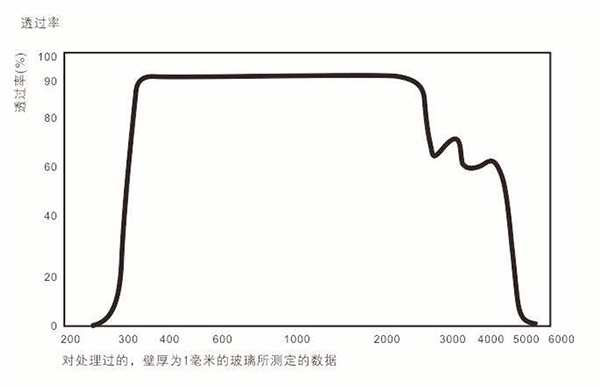
3.3 High borosilicate glass can penetrate 92% of visible light without significant absorption in the visible spectrum, making it clear and colorless.
During the photochemical process of glass devices, the transparency of 3.3 high borosilicate glass to ultraviolet light is particularly important.
The ultraviolet transmittance with a wavelength of 360-400nm is 90-92%, and the infrared transmittance is also 92%. Due to its ability to transmit ultraviolet light, photochemical reactions such as chlorination and chlorosulfonation can be achieved in this material.
Chlorine molecules absorb within the range of 280 to 400 nanometers, thus serving as a radiative energy carrier.
For the use of photosensitive substances, the glass surface can appear brown, which can strongly absorb light in the short wave range. The absorption range of brown glass is around 500 millimicrons.
Address: 5D Yaohai City Industrial Park, Yaohai District, Hefei City, Anhui China
Whatsapp:+86 15665455996
Tel:+86 13053083981
E-mail:youngmanglassreactor@gmail.com
Zip Code: 230011

Tiktok